Repetitive Stress Injuries
Repetitive stress injuries rarely arrive suddenly. They build gradually through months of the same movements, the same postures and the same loads, until one day the pain is persistent enough that you cannot work around it anymore.
That progression matters because by the time most people book an appointment, the condition is well established and the habits driving it are deeply ingrained. Getting on top of it early produces considerably better outcomes. But even long-standing RSI, the kind that has been present for months or years, responds well to the right treatment approach.
At Nudge Osteopathy in Wantirna, we assess the full picture behind your RSI, treat the affected structures properly, and address the contributing factors that allowed the injury to develop in the first place.

What is a repetitive stress injury?
Repetitive stress injury, also referred to as repetitive strain injury or overuse syndrome, describes a range of conditions caused by performing the same movements repeatedly over time, or maintaining sustained postures without adequate variation and recovery.
The body is highly adaptable, but it has limits. When the same muscles, tendons and joints are loaded in the same way day after day without sufficient recovery, the tissue gradually becomes irritated, loses its capacity to cope with load and begins to break down. The result is pain, weakness and reduced function that does not resolve with rest alone.
Common contributing factors include repetitive movements performed hundreds or thousands of times daily, sustained awkward postures such as working with the wrist flexed or the shoulder elevated, static loading where muscles remain contracted for extended periods, insufficient variation or recovery time, forceful exertions like heavy gripping or intensive keyboard use, vibrating tools and equipment, poorly fitted workstations, and the physical effects of sustained mental stress.
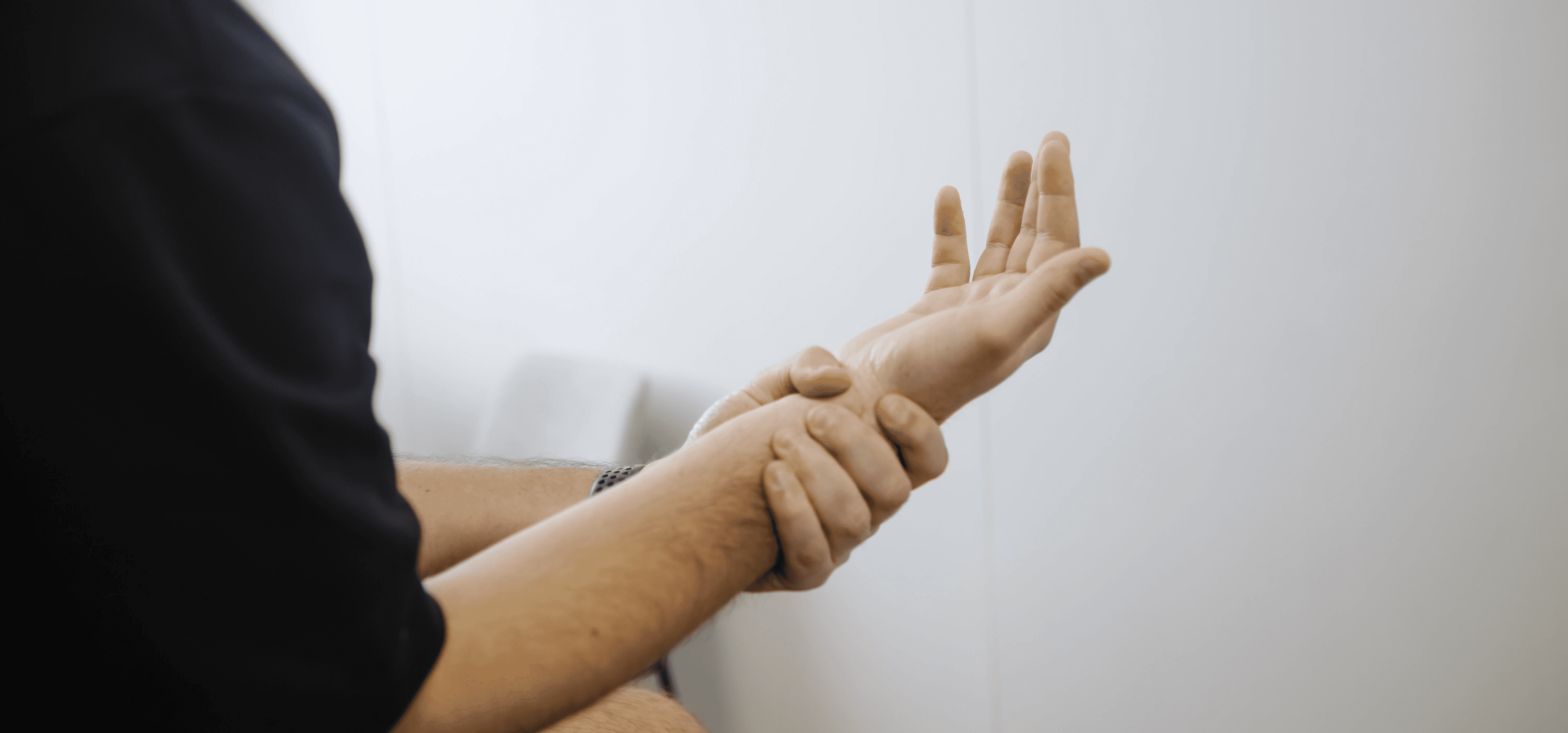
Conditions we commonly treat
Tennis elbow (lateral epicondylitis)
Golfer's elbow (medial epicondylitis)
Carpal tunnel syndrome
De Quervain's tenosynovitis
Thoracic outlet syndrome
Achilles tendinopathy
Plantar fasciitis
Patellar tendinopathy
Shin splints and IT band syndrome
RSI by occupation
The pattern of RSI varies considerably by how you use your body day to day.
Office workers and IT professionals most commonly present with tennis elbow from sustained mouse use, carpal tunnel syndrome, upper back and neck tension from prolonged static posture, and diffuse forearm pain. Treatment addresses both the affected tissue and the workstation factors maintaining the load.
Tradespeople commonly present with tennis and golfer's elbow from gripping tools, shoulder tendinopathy from overhead work, hand and wrist pain from vibrating equipment, and lower back strain from repetitive lifting. Management involves technique modification, strengthening for job-specific demands and hands-on treatment.
Healthcare workers, hairdressers, parents and musicians each carry their own distinct load patterns and their own predictable RSI presentations. Whatever your occupation, the approach is the same: understand how you use your body, identify where the load is exceeding capacity, treat the injury and modify the cause.
How we treat RSI at Nudge Osteopathy
Assessment comes first. Your initial appointment runs 60 minutes. We take a detailed history covering your work, hobbies and daily activities, assess your posture and movement patterns, perform specific orthopaedic tests for the suspected condition, screen for nerve involvement where appropriate and identify the muscle imbalances contributing to the problem. If your workstation setup is relevant, bring photos. We will look at them.
Treatment addresses both the injured tissue and the underlying cause. Manual therapy for the soft tissue includes deep tissue work, myofascial release, trigger point therapy and cross-friction massage for chronic tendinopathies. Joint mobilisation restores movement in stiff wrist, elbow, shoulder and spinal segments. Neural mobilisation addresses nerve involvement in conditions like carpal tunnel syndrome and thoracic outlet syndrome.
Exercise rehabilitation is the component that determines long-term outcomes. Eccentric loading is the gold standard for tendinopathy rehabilitation. Nerve gliding addresses nerve compression conditions. Specific strengthening targets the muscles that should be sharing load but are not. Movement retraining changes how you perform the tasks that caused the injury in the first place.
Ergonomic and lifestyle modification runs alongside treatment throughout. Screen height, chair setup, keyboard and mouse position, tool selection, grip technique, activity pacing and structured microbreaks all contribute to how quickly and completely you recover, and whether the injury comes back.
When to book
It is worth booking an appointment if your pain has persisted beyond a few days, it is affecting your ability to work or carry out daily tasks, you are noticing numbness, tingling or burning in the affected area, or you have modified your activities and the pain continues regardless. The earlier you address an overuse injury, the better the outcome. What starts as a minor ache has a way of becoming a chronic limitation if left unmanaged.
If you experience sudden severe weakness in a hand or arm, significant swelling, redness or warmth in a joint, or colour changes in the fingers, seek medical attention rather than booking with us.
